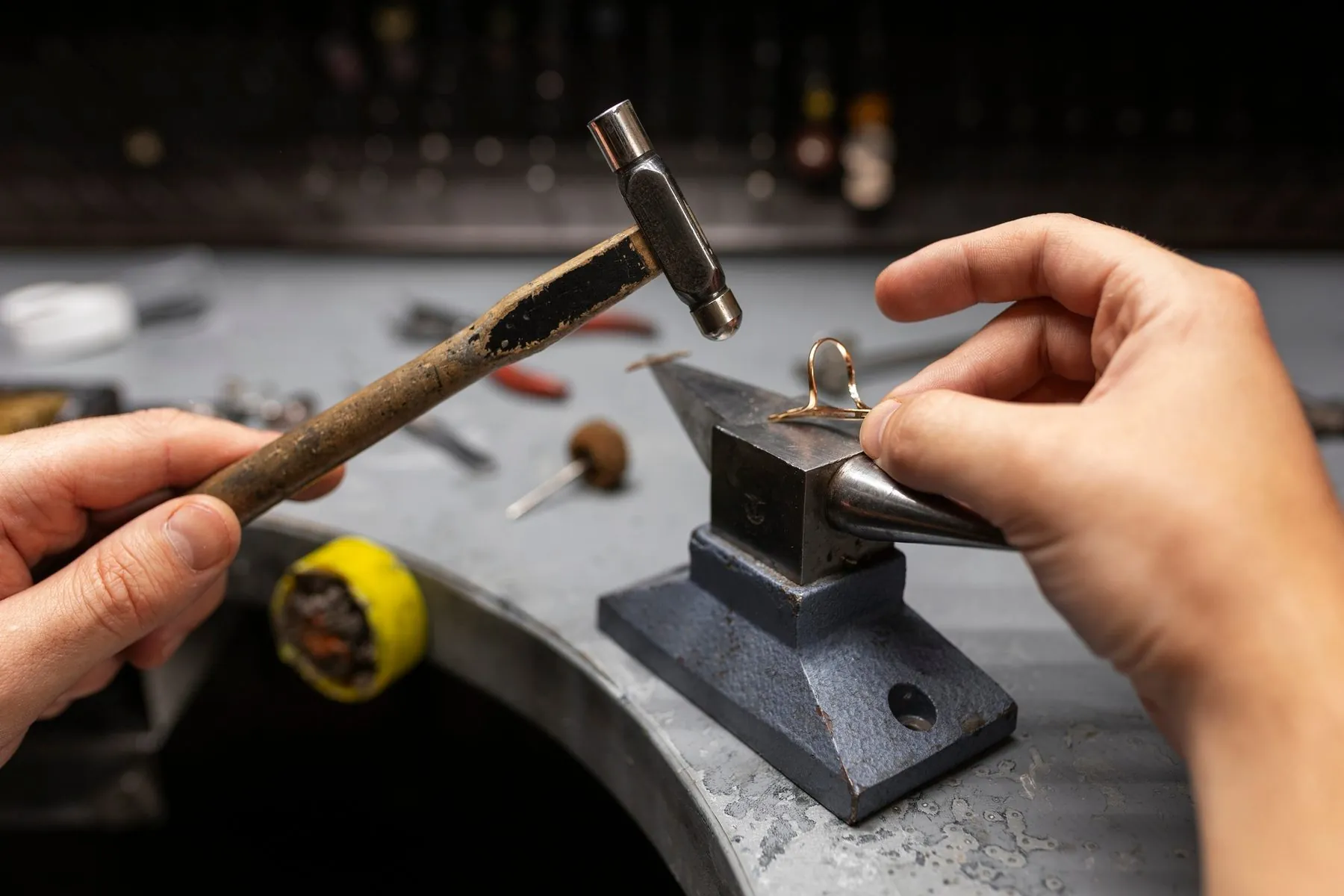
Different metals, different heat
The repair that works on gold will ruin silver, and neither approach works on platinum. Platinum needs far more heat than gold does. Silver discolours and moves if it is rushed. Knowing which is which, and having the right solder for each, is most of the job.
That is the argument for a jeweler at a bench rather than an envelope in the post. Someone has to look at the piece, identify what it actually is — not what it is stamped, which is not always the same thing — and pick the method to match. Here that person is standing in front of you and can explain what they are about to do before they do it.
- 10k, 14k, 18k and 24k gold in yellow, white and rose.
- Sterling silver, handled at the lower heat it needs.
- Platinum, which takes its own solder and its own temperature.
- Mixed-metal pieces, where the two halves need different treatment in the same repair.
Walk in during mall hours.
Gold
Karat tells you how much gold is in the alloy. 10k is harder and more scratch-resistant but more prone to cracking at a stress point. 14k is the everyday compromise and most of what we see. 18k is richer in colour and softer, so prongs wear faster.
Repairs have to be made with solder matching both the karat and the colour. Yellow solder on a rose gold ring shows, and it shows permanently.
Rose gold gets its colour from copper, which makes it less forgiving under heat. White gold is plated with rhodium, so any repair needs replating afterwards to keep the colour even.
Silver
Sterling is 92.5% silver. It conducts heat faster than gold, so it needs a different approach — too slow and the heat spreads through the whole piece and firescale appears around the joint as a grey shadow.
Silver tarnishes, which is a surface reaction, not damage. It cleans off. Deep black tarnish in a crevice takes hand work.
Platinum
Platinum is dense, and it does not wear away so much as move — scratches push metal aside rather than remove it, which is why old platinum develops a patina rather than getting thin.
It melts far hotter than gold and needs its own tools and its own solder. A repair done with gold solder on platinum is visible forever and weaker than it should be.
Mixed metal pieces
Two-tone rings, silver with gold accents, platinum heads on gold shanks. These need the lower-melting metal protected while the join is made — often a job for laser welding rather than a torch.
Metals, karats and colours
10k, 14k, 18k and 24k gold in yellow, white and rose; sterling silver (.925); platinum; tungsten; titanium; and stainless steel.
We test unknown metal in front of you before quoting — acid test or electronic tester — so you know what you actually have. Plated and filled pieces are often repairable too, but they behave differently under heat and we will tell you what to expect.
What we repair in each
- Gold — sizing, soldering, re-shanking, rebuilding worn areas, matching colour across yellow, white and rose.
- Sterling silver — soldering, straightening, de-tarnishing, and rhodium plating if you want it to stay bright.
- Platinum — laser welding, prong work and sizing. Platinum needs a different technique and a higher temperature than gold; doing it the gold way leaves a visible join.
Buying gold and silver
We buy gold and silver at the counter — chains, broken pieces, single earrings, class rings, dental gold and scrap. It is tested and weighed in front of you and you get the figure before you decide. If the piece is worth more repaired than melted, we will say so.
What will it cost?
What is it actually made of — 10k, 14k, 18k, sterling, platinum? Is it stamped, or does it want testing? Is it plated over something else? Are there stones near the repair that will not take heat? Is it one metal, or a mixed piece? We cannot answer a single one of those without the piece in front of us. Bring it by Orland Square Mall and we will tell you what it needs and what it comes to, before anything starts.
Straight to your question
- Gold jewelry repair
- Sterling silver jewelry repair
- Platinum jewelry repair
- Rose gold jewelry repair
- Gold plated and gold filled repair
- Stainless steel jewelry repair
- Costume jewelry repair
Questions we get asked
How long do repairs take?
Most are same day. Platinum work sometimes takes longer because of the temperatures involved, and we will tell you at the counter if that applies to your piece.
Can gold and silver be soldered together?
They can, but it needs care — the two metals melt at different temperatures and a repair done at the wrong heat will damage the softer one. It is a job for a bench, not a mail-in envelope.
Can you repair sterling silver?
Yes. Silver needs different solder and a different heat approach from gold, otherwise you get a grey shadow around the repair.
Is platinum harder to repair than gold?
Different rather than harder. It runs much hotter and needs its own solder and tools. Repaired with gold solder it is visibly wrong and permanently weaker.
Can you tell what my jewellery is made of?
Usually from the hallmark, and we can test where there is no mark.
Can white gold and yellow gold be joined?
Yes. Mixed metals are routine — laser welding handles them particularly cleanly.
Do you work on gold filled or plated jewellery?
Sometimes, with limits — plating is thin and heat marks it. We will tell you straight whether a repair will look right before we take it on.
Bring it in — or ask first
Walk in during mall hours and we will price it at the counter, in writing, before anything is touched. If you would rather ask first, send a couple of details and we will call you back.
Bring it in today, wear it tonight
We are inside Orland Square Mall in Orland Park. Walk in during mall hours, no appointment — most repairs are finished the same day and many while you wait. Or send a few details and we will call you back with a price.
Where we are
Julio's Jewelry, 800 Orland Square Drive, Orland Park, IL 60462 — inside Orland Square Mall. Mon–Thu 10am–8pm · Fri–Sat 10am–9pm · Sun 11am–6pm.
Metal repair work comes in from Blue Island, South Holland, Lansing, Calumet City and over the Indiana line.